
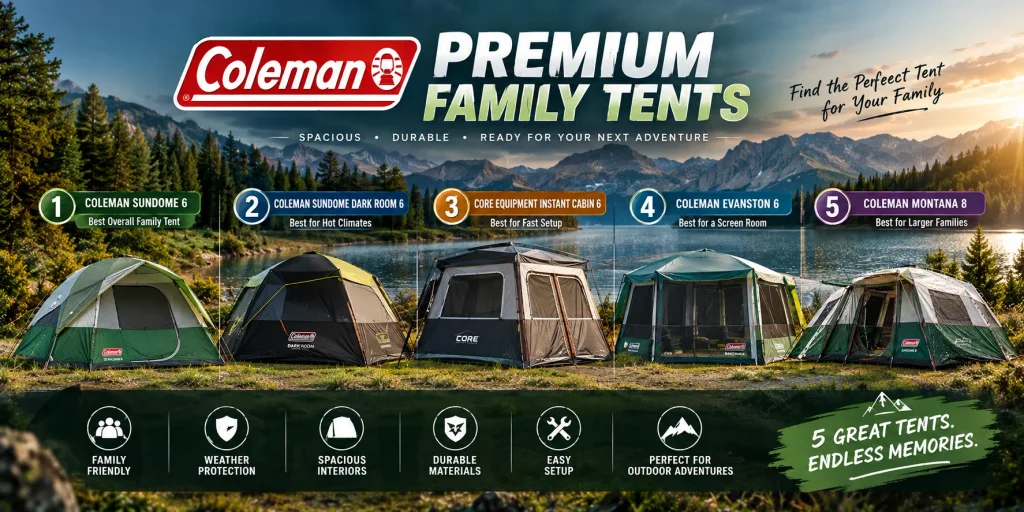
Overall Tested Score
Coleman Sundome 6 — 7.8 / 10
It earns the top spot because it nails the basics every family actually needs: real headroom, dependable rain protection, and a setup you can manage solo without the price tag or bulk of a bigger tent.
Quick Answer
The best family tents in 2026 balance space, weatherproofing, and setup speed without demanding an engineering degree to pitch. Our top pick is the Coleman Sundome 6 for its all-around value and rain performance, the Coleman Sundome Dark Room 6 for hot-climate campers who want a cooler, darker tent, and the Core Equipment Instant Cabin 6 for anyone who wants setup done in minutes flat.
What We Tested It On
Every family tent on this list is scored out of 10 across eight categories that actually matter on a real trip:
- Spaciousness — floor area and how many people/pads it realistically fits
- Quality — pole material, fabric, stitching, zippers
- Ease of Use — how manageable setup and takedown are solo
- Comfort — livability once you’re actually inside
- Features — extras like porches, dividers, or blackout fabric
- Ventilation — mesh panels, cross-airflow, how it handles a hot night
- Rain Protection — how long it holds up before the first leak
- Portability — packed weight and size for loading the car
For the Sundome 6, that shakes out to strong marks in spaciousness (8.5) and ventilation (8.5), solid rain protection (8), and an ease-of-use score (7) that reflects a straightforward, if not instant, pole-and-clip setup.
Product Basic Info
All five tents on this list come from two budget-friendly, widely available brands, Coleman and Core Equipment, and share a common category: 6- to 8-person dome and cabin-style family tents built for warm-weather car camping, not backpacking or winter use. They’re aimed at families who want to fit a few sleeping pads or a couple of queen-sized air mattresses under one roof, set up close to the car, and take down again without a headache.
None of these are 4-season tents, and none are built to be carried on a trail; they’re designed to get pulled out of a trunk, pitched at a campsite or in a backyard, and packed away a few days later.
Test Section
1. Coleman Sundome 6 Best Overall Family Tent
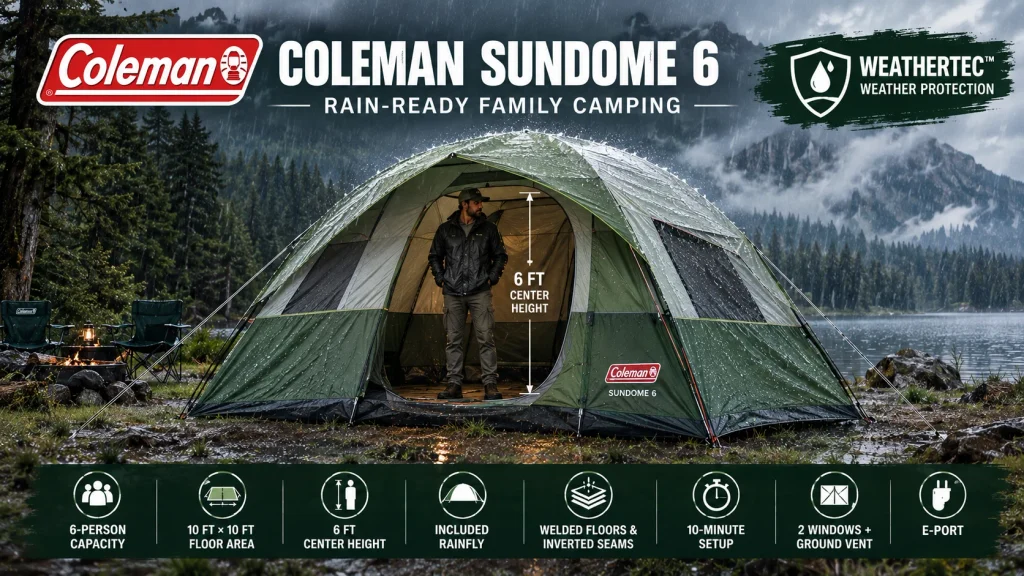
The Sundome 6 is the tent we keep coming back to when someone asks for one no-nonsense recommendation. It’s a classic dome shape, built to go up fast and shrug off a summer storm.
In the Box Tent body, rainfly, shock-corded fiberglass pole set, stakes, guylines, and a carry bag.
Setup & Take Down
- Setup Time: About 11.5 minutes solo, once you’ve done it once or twice.
- Setup Guide: Lay out the tent body, slide the fiberglass poles through the exterior sleeves, clip the body to the poles, stake the corners, then throw the rainfly over the top and clip it down. No hubs, no separate frame to assemble first; it’s a two-pole dome, so most of the time goes into staking it out properly.
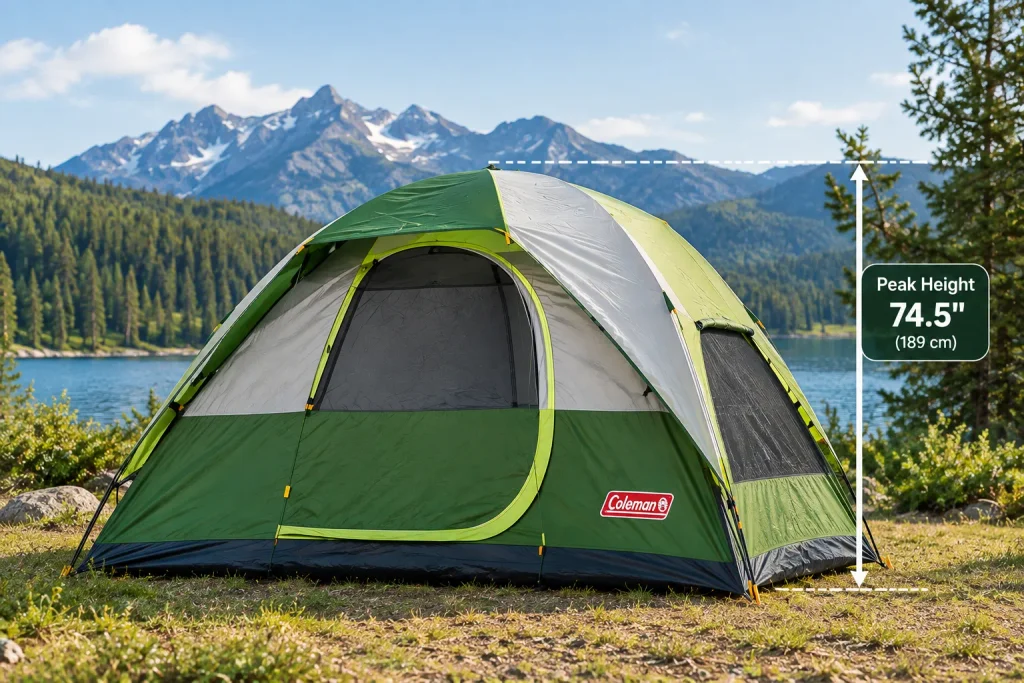
- Peak Height: 74.5 inches tall enough for most adults to stand fully upright near the center.
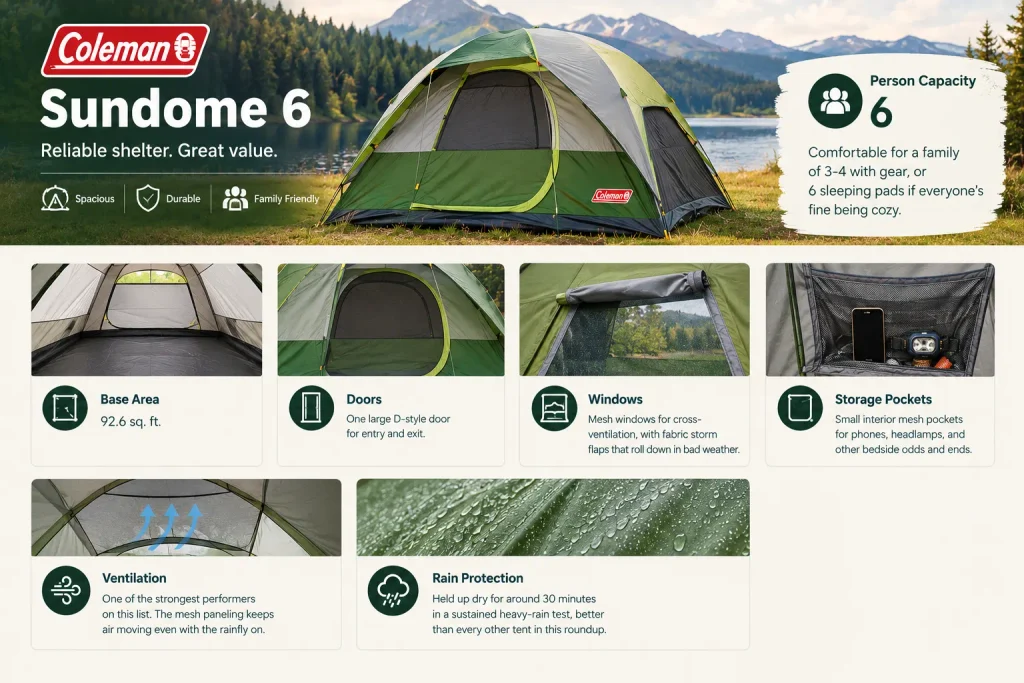
Person Capacity: Listed for 6, realistically comfortable for a family of 3-4 with gear, or 6 sleeping pads if everyone’s fine being cozy.
Base Area: 92.6 sq. ft.
Doors: One large D-style door for entry and exit.
Windows: Mesh windows positioned for cross-ventilation, with fabric storm flaps that roll down in bad weather.
Room Divider: None this is a single open room, which is normal at this size and price point.
Storage Pockets: Small interior mesh pockets for phones, headlamps, and other bedside odds and ends.
Ventilation: One of the strongest performers on this list. The mesh paneling keeps air moving even with the rainfly on, which matters a lot on a warm night.
Rain Protection: This is where the Sundome 6 separates itself from the rest of the budget pack. In a sustained heavy-rain test, it held up dry for around 30 minutes before any water worked its way in, better than every other tent in this roundup. Like nearly every tent in this price bracket, it will eventually let water through the inverted floor seam in a true downpour, so a bottle of seam sealer on that seam before your first trip is money well spent.
Portability: 16.0 lbs packed light enough for one person to carry from the car to the campsite without much trouble.
Quality: Fiberglass poles, a polyester tent body, and a genuine bathtub-style floor. It’s not premium hardware, but it’s held up over years of repeated use for us, which says a lot at this price.
| Spec | Detail |
|---|---|
| Capacity | 6-person |
| Peak Height | 74.5 in |
| Base Area | 92.6 sq. ft. |
| Setup Time (solo) | 11.5 mins |
| Packed Weight | 16.0 lbs |
Pros
- Excellent value for the price
- Genuinely six-foot-plus headroom
- Best rain performance of any tent on this list
- Comfortably fits a family of 3-4
Cons
- No standout weaknesses at this price point
Verdict: If you only need one family tent recommendation, this is it dependable, roomy enough, and the best rain protection of the bunch.
We may earn a commission from qualifying purchases at no extra cost to you.
2. Coleman Sundome Dark Room 6 Best for Hot Climates
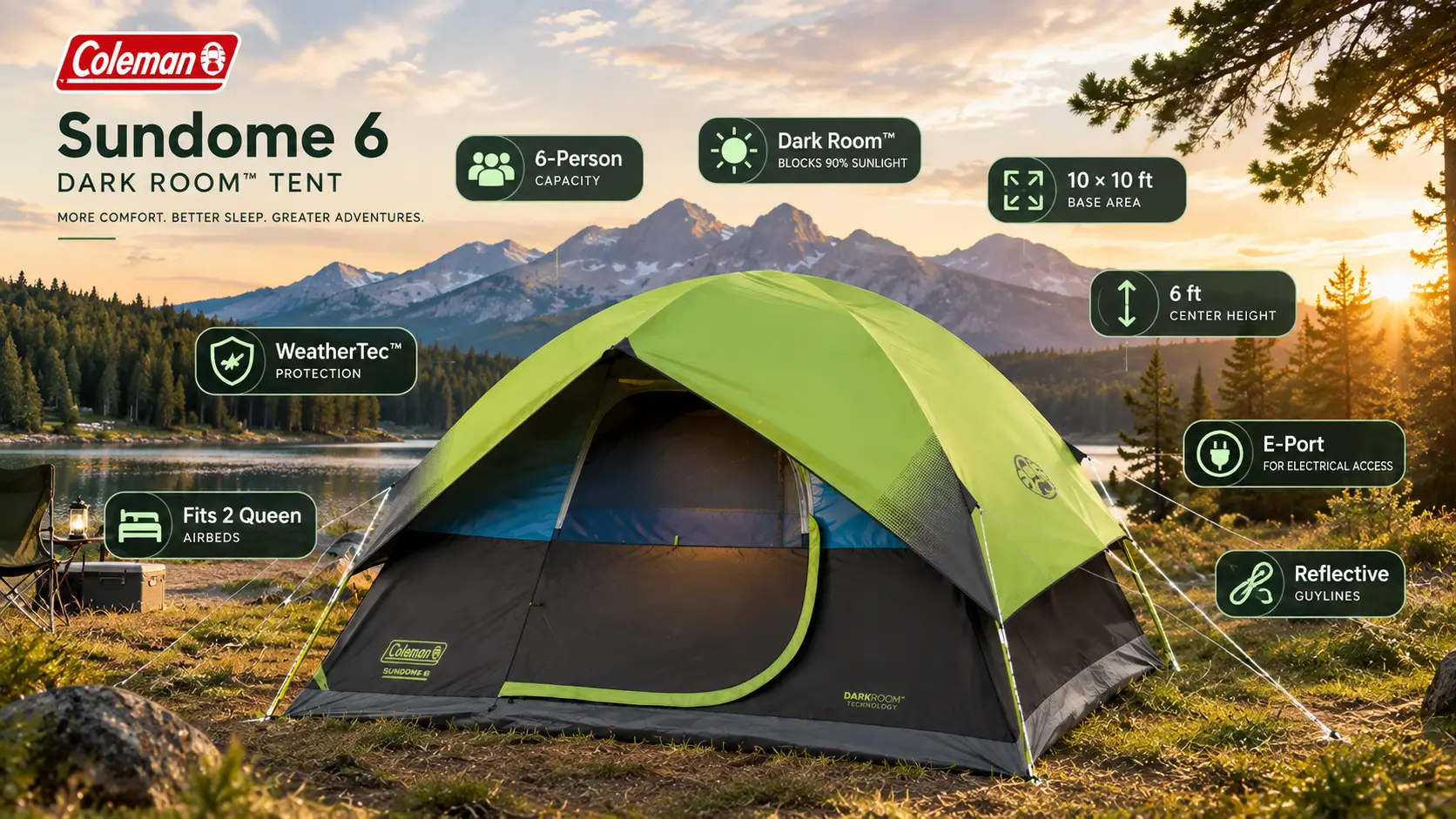
This is the same trusted Sundome 6 platform, but with one meaningful upgrade: a blackout fabric that cuts down on sunlight and heat.
In the Box Tent body with Dark Room fabric panels, rainfly, fiberglass pole set, stakes, guylines, carry bag.
Setup & Take Down
- Setup Time: About 11.5 minutes solo identical to the regular Sundome 6, since the shape and pole structure are unchanged.
- Setup Guide: Same two-pole dome process: thread the poles through the sleeves, clip the body on, stake the corners, add the rainfly.
- Peak Height: 73.0 inches.
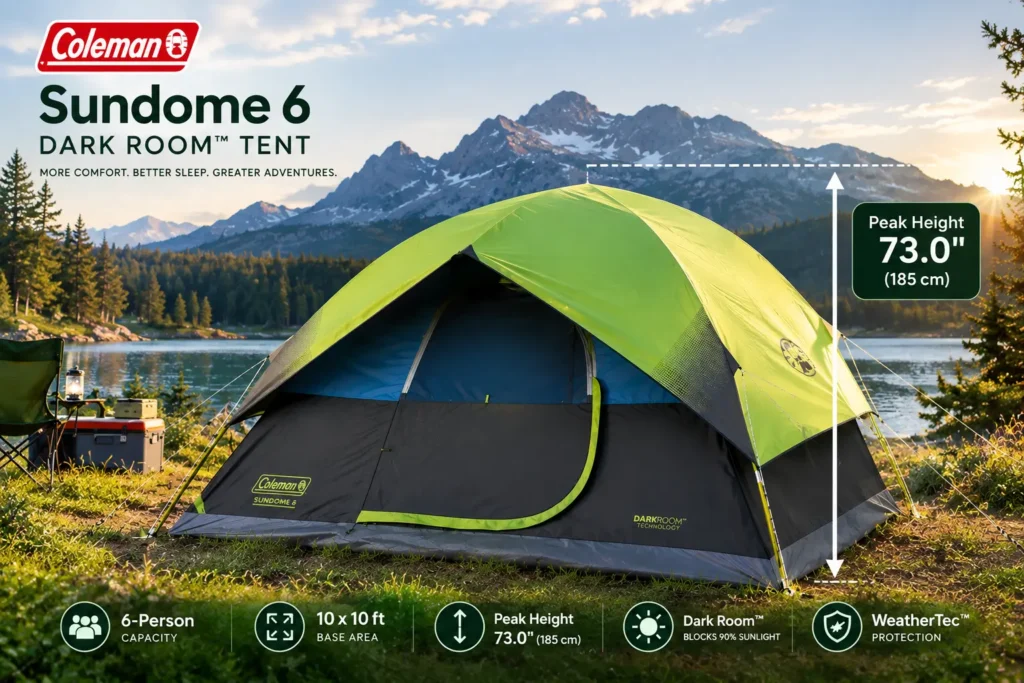
Person Capacity: 6-person rated, comfortable for a family of 3-4.
Base Area: 95.1 sq. ft. slightly larger footprint than the standard Sundome 6.
Doors: One D-style door.
Windows: Mesh windows, though the blackout fabric means less ambient light comes through them compared to a standard tent panel.
Room Divider: None.
Storage Pockets: Small interior mesh pockets, same as the standard Sundome.
Ventilation: Strong, though slightly behind the standard Sundome 6 since the darker fabric trades a touch of airflow for the blackout effect and a noticeably cooler interior on hot days.
Rain Protection: Matches the standard Sundome 6 almost exactly around 30 minutes of dry performance in a heavy-rain test before the first drops work through.
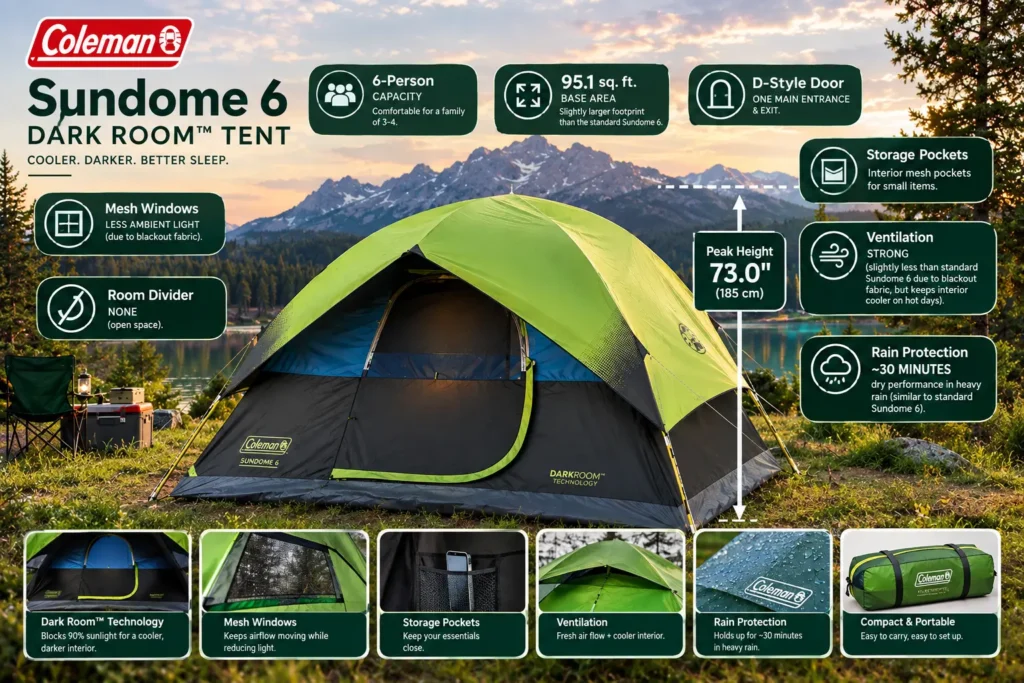
Portability: 16.4 lbs just 0.4 lbs heavier than the regular Sundome 6, which is a non-issue in practice.
Quality: Same fiberglass pole and bathtub-floor construction as the Sundome 6, with the added Dark Room fabric treatment.
| Spec | Detail |
|---|---|
| Capacity | 6-person |
| Peak Height | 73.0 in |
| Base Area | 95.1 sq. ft. |
| Setup Time (solo) | 11.5 mins |
| Packed Weight | 16.4 lbs |
Pros
- All the strengths of the standard Sundome 6
- Noticeably cooler and darker inside great for hot-summer trips or late sleepers
- Barely any weight or setup-time penalty
Cons
- Costs a little more than the standard Sundome 6
Verdict: If you camp mostly in summer heat, this upgrade over the base Sundome 6 is worth the small price difference.
We may earn a commission from qualifying purchases at no extra cost to you.
3. Core Equipment Instant Cabin 6 Best for Fast Setup
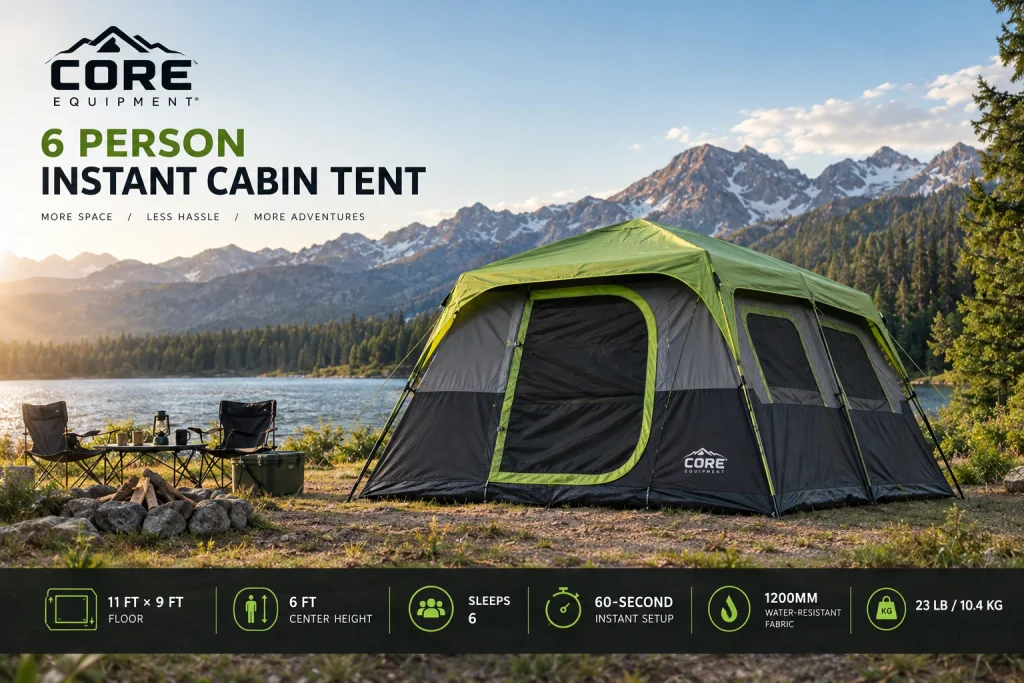
If setup speed is your top priority, this is the tent to look at. The poles come pre-attached to the tent body, so there’s no threading anything through sleeves.
In the Box Tent body with pre-attached steel pole frame, rainfly, stakes, guylines, carry bag with wheels on larger sizes.
Setup & Take Down
- Setup Time: Roughly 12 minutes solo on the larger 9-person version we’ve spent the most time with the 6-person version, being smaller, should come together at least as fast, likely a couple of minutes quicker.
- Setup Guide: Unfold the frame, extend the pre-attached telescoping legs, and stand it up no separate poles to feed through channels. This mechanism is the fastest, least fiddly setup process of any tent on this list, and take-down is just as quick since nothing needs disassembling into loose pole segments.
- Peak Height: The 9-person version we tested measures 75.5 inches; expect the 6-person model to run slightly lower given its smaller footprint.
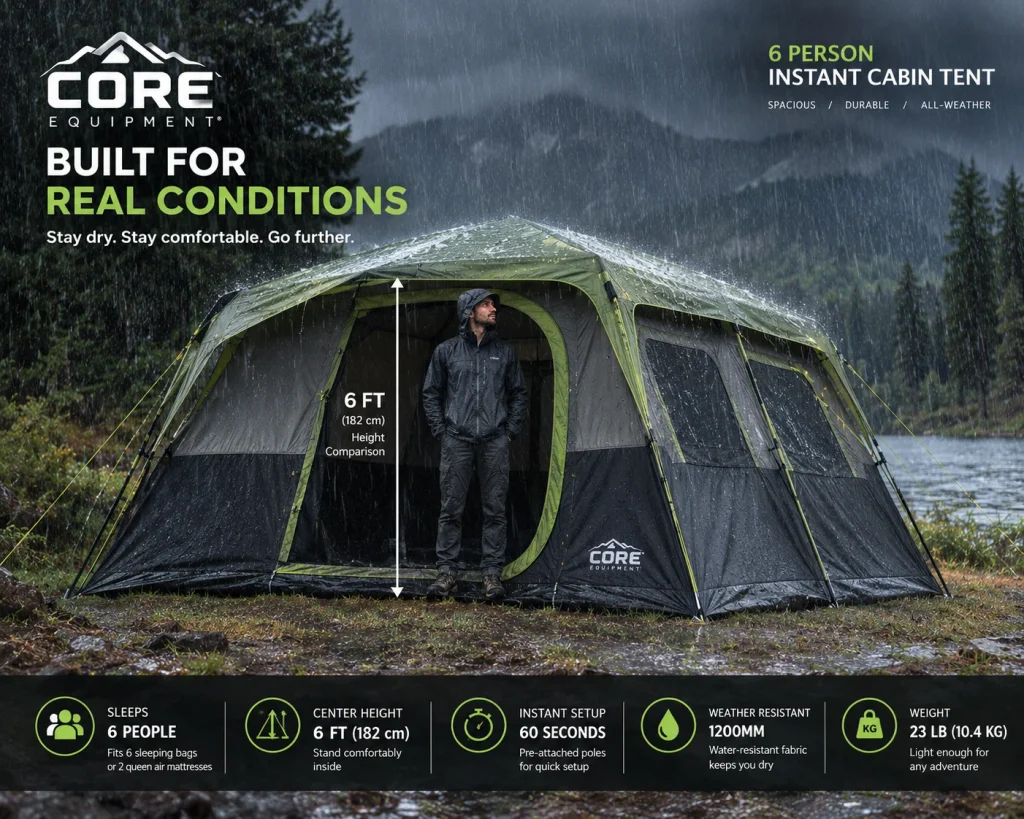
Person Capacity: 6-person rated (we tested Core’s larger 9-person sibling, which shares the same instant-frame design).
Base Area: Exact 6-person base area varies by listing the larger 9-person version we measured comes in at 118.1 sq. ft., so expect a noticeably smaller footprint on the 6P.
Doors: A single door on the 6-person model the step-up 9-person version adds larger doors and more mesh, so if door size matters a lot to you, it’s worth comparing listings.
Windows: Mesh windows for airflow, sized modestly on the 6-person version.
Room Divider: None included at this capacity.
Storage Pockets: Interior mesh pockets for small gear.
Ventilation: A genuine strength of the instant-cabin design cross-flow from the mesh panels kept the interior noticeably fresh in our testing.
Rain Protection: The weakest point of this tent. It held up fine through an hour of light rain, but a sustained heavy-rain test got through fairly quickly, mainly through an untaped floor seam and around the window latch hardware. If you’re expecting a real storm, this isn’t the tent to trust without extra seam sealing.
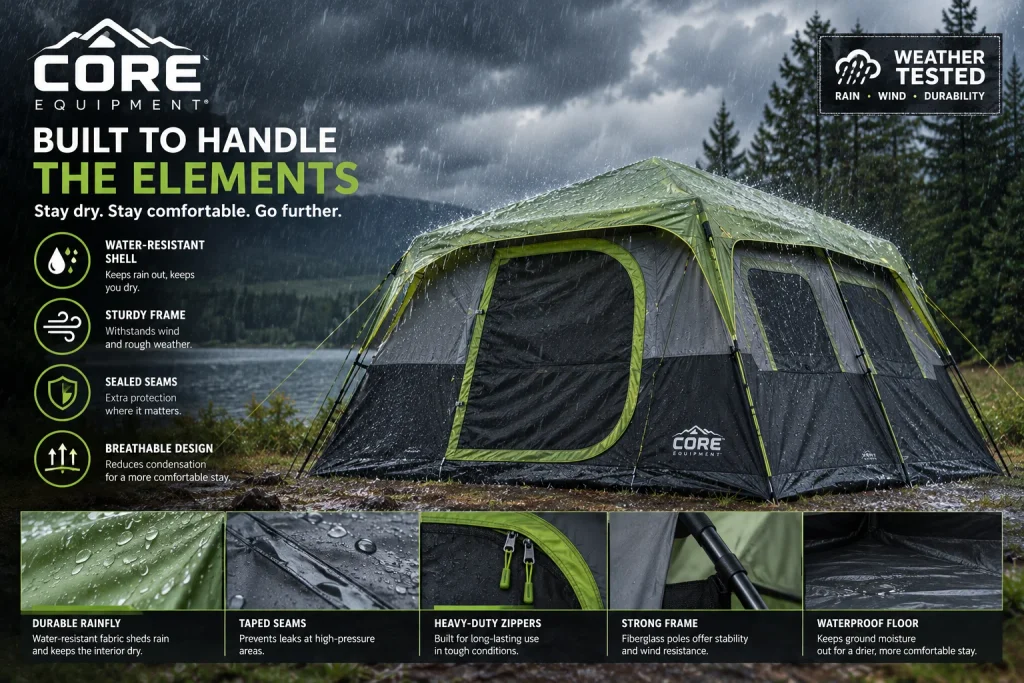
Portability: The 9-person version we handled weighs 30.0 lbs packed and takes up a noticeably bigger bag than any dome tent on this list the trade-off for the rigid pre-attached frame. The 6-person model will be lighter and more compact, but still bulkier than a comparable dome tent.
Quality: Full steel poles rather than fiberglass, which is a real upgrade in durability this is the best-built instant mechanism we’ve tested in the budget category.
| Spec | Detail |
|---|---|
| Capacity | 6-person |
| Peak Height | ~75.5 in (9P tested) |
| Base Area | ~118.1 sq. ft. (9P tested) |
| Setup Time (solo) | ~12 mins |
| Packed Weight | ~30.0 lbs (9P tested) |
Pros
- Fastest, easiest setup of any tent on this list
- Sturdy steel pole frame instead of fiberglass
- Poles, clips, and guylines all pre-attached
Cons
- Weakest rain protection of the five tents here
- Bulkier packed size than the dome-style options
Verdict: Choose this one if setup speed and frame durability matter more to you than top-tier rain protection.
We may earn a commission from qualifying purchases at no extra cost to you.
4. Coleman Evanston 6 Best for a Screen Room
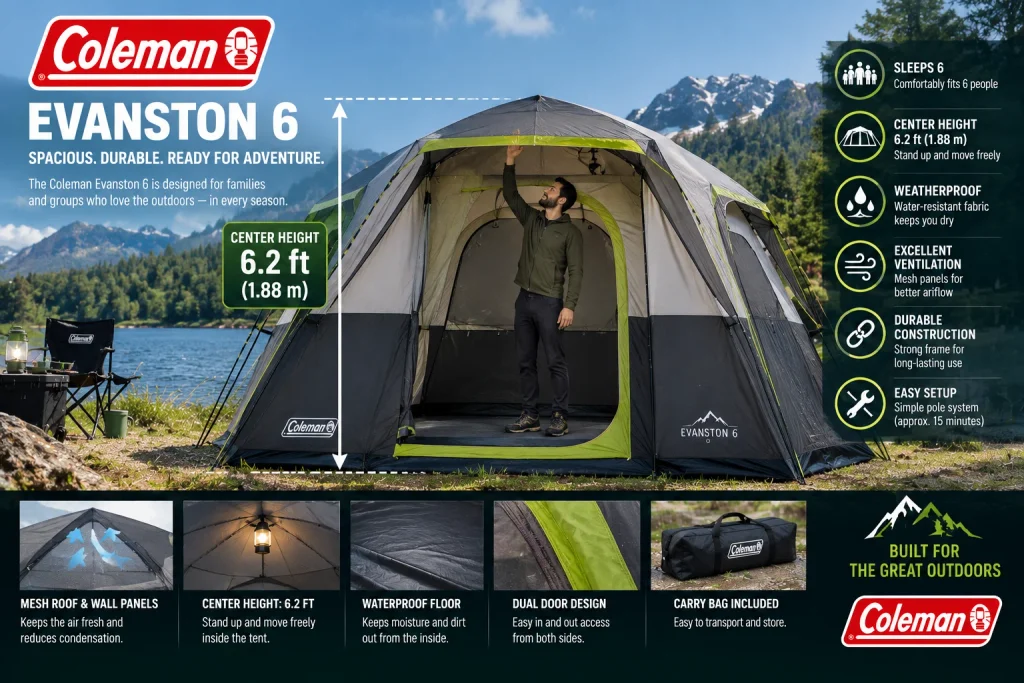
The Evanston 6 takes the familiar Sundome shape and bolts a full screen room onto the front a genuinely useful add-on for bug season.
In the Box Tent body, attached screen room section, rainfly, fiberglass pole set, stakes, guylines, carry bag.
Setup & Take Down
- Setup Time: About 17.5 minutes solo longer than the plain Sundome, since there’s an extra structure (the screen room) to pole and stake out.
- Setup Guide: Same dome-and-sleeve process as the Sundome for the sleeping area, then a second, simpler pole set for the screen room frame in front.
Peak Height: 68.5 inches a little lower than the Sundome 6, since some of the structure’s height goes into the screen room instead.
Person Capacity: 6-person rated for the sleeping area.
Base Area: 83.9 sq. ft. of enclosed tent space, plus 42.3 sq. ft. of screened porch 126.2 sq. ft. total, more usable area than some 8-person tents.
Doors: A door into the sleeping compartment, plus a separate zippered entry into the screen room.
Windows: Mesh windows in the sleeping area; the screen room itself is essentially one large mesh wall.
Room Divider: None between sleeping areas, though the screen room functions as a separate zone from the main tent body.
Storage Pockets: Small interior mesh pockets in the sleeping compartment.
Ventilation: Excellent, helped enormously by the screen room, which gives you a fully bug-free space to sit in without being sealed into the tent body.
Rain Protection: The sleeping compartment performs about as well as the standard Sundome 6. The screen room is the catch there’s very little rainfly coverage over it, so it gets soaked in anything more than a light drizzle. If you want to use the screen room in wet weather, plan on rigging a tarp over it.
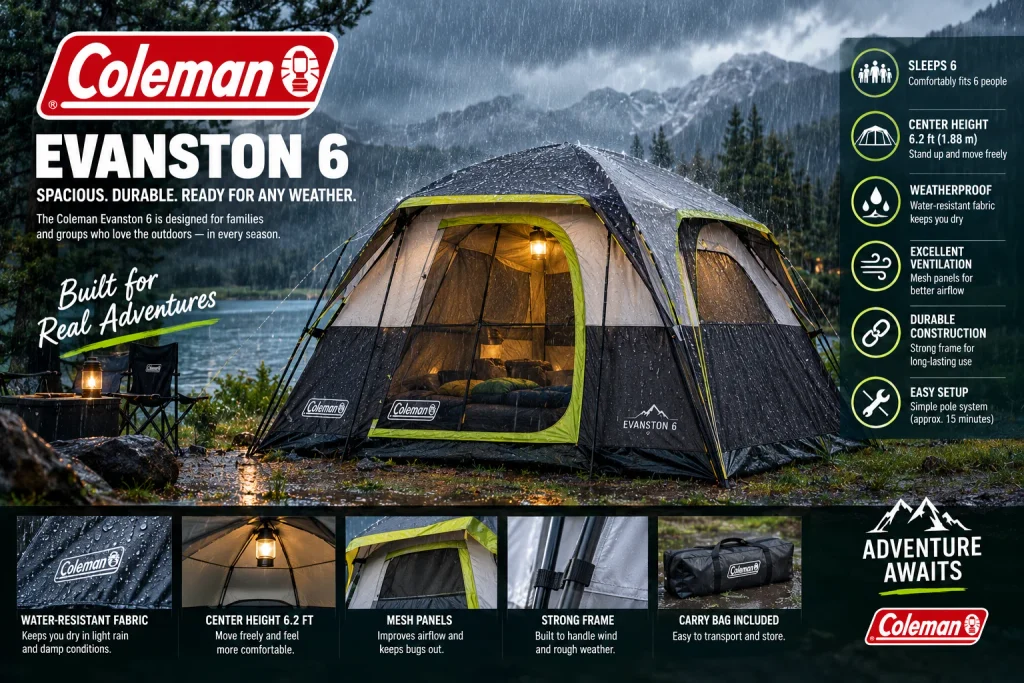
Portability: 19.4 lbs packed noticeably heavier than the plain Sundome, which tracks given the extra screen-room fabric and poles.
Quality: Same fiberglass-and-polyester build as the rest of the Coleman lineup here.
| Spec | Detail |
|---|---|
| Capacity | 6-person + screen room |
| Peak Height | 68.5 in |
| Total Area | 126.2 sq. ft. |
| Setup Time (solo) | 17.5 mins |
| Packed Weight | 19.4 lbs |
Pros
- Genuinely useful bug-free screen room
- Huge total usable area for the size class
- Shares all the reliability of the Sundome platform
Cons
- Screen room offers almost no rain protection
Verdict: A great pick if you spend a lot of time lounging outside the sleeping area and want to keep bugs out just don’t expect the porch to stay dry in a storm.
We may earn a commission from qualifying purchases at no extra cost to you.
5. Coleman Montana 8 Best for Larger Families
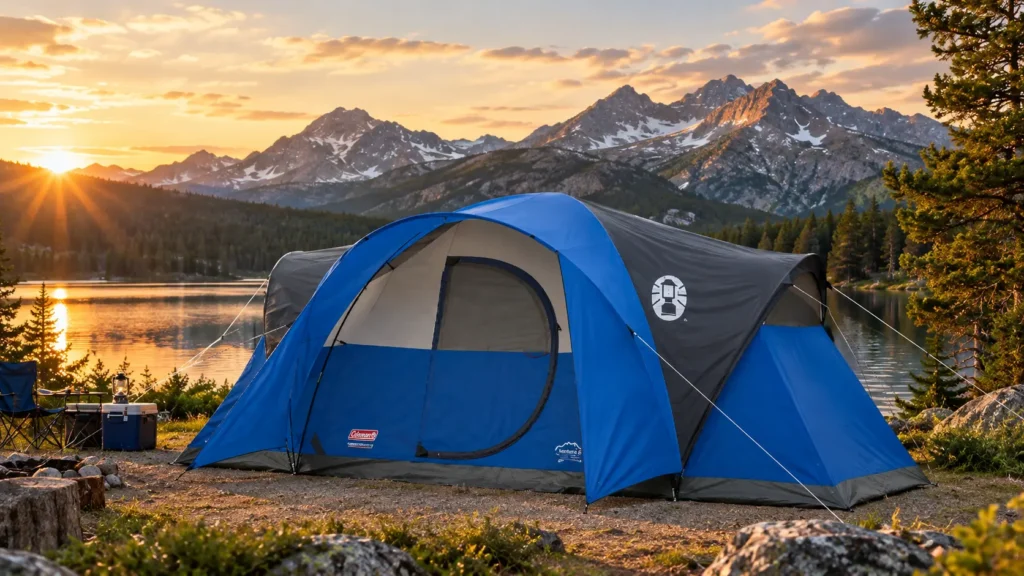
The Montana 8 is essentially an upsized Sundome same DNA, more room, and a couple of extra features to justify the bigger footprint.
In the Box Tent body, rainfly, fiberglass pole set, stakes, guylines, carry bag.
Setup & Take Down
- Setup Time: About 22 minutes solo the longest on this list, which makes sense given the larger footprint. A second person cuts this close to in half.
- Setup Guide: Same fundamental dome process as the Sundome 6, just with a bigger tent body and more staking points to secure.
Peak Height: 74.0 inches matching the Sundome despite the larger floor plan.
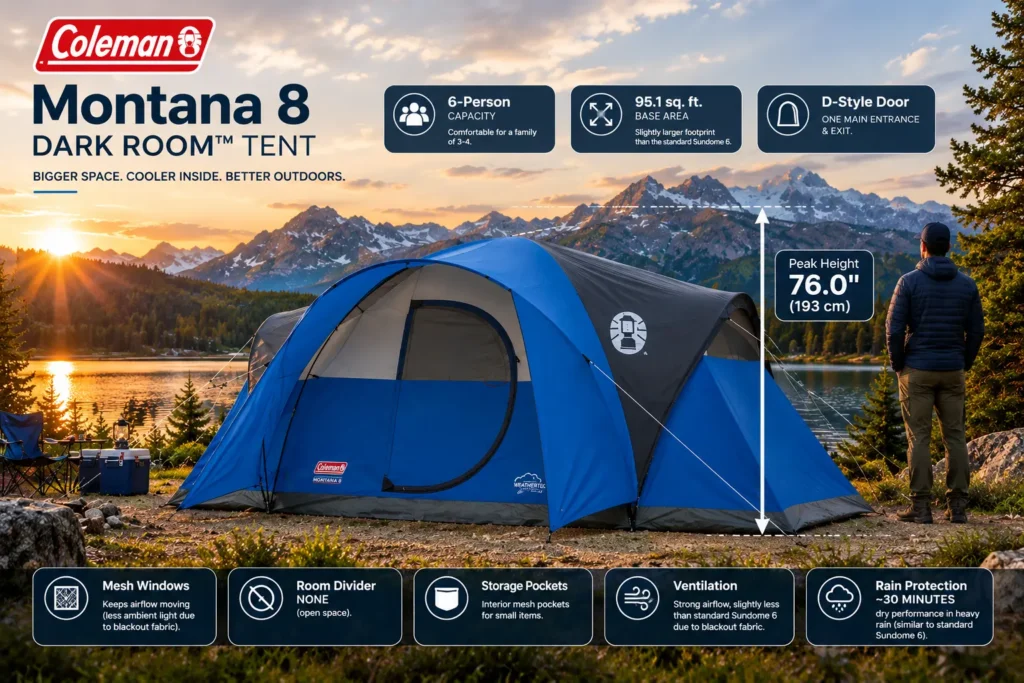
Person Capacity: 8-person rated, realistically comfortable for a family of 5-6.
Base Area: 103.5 sq. ft.
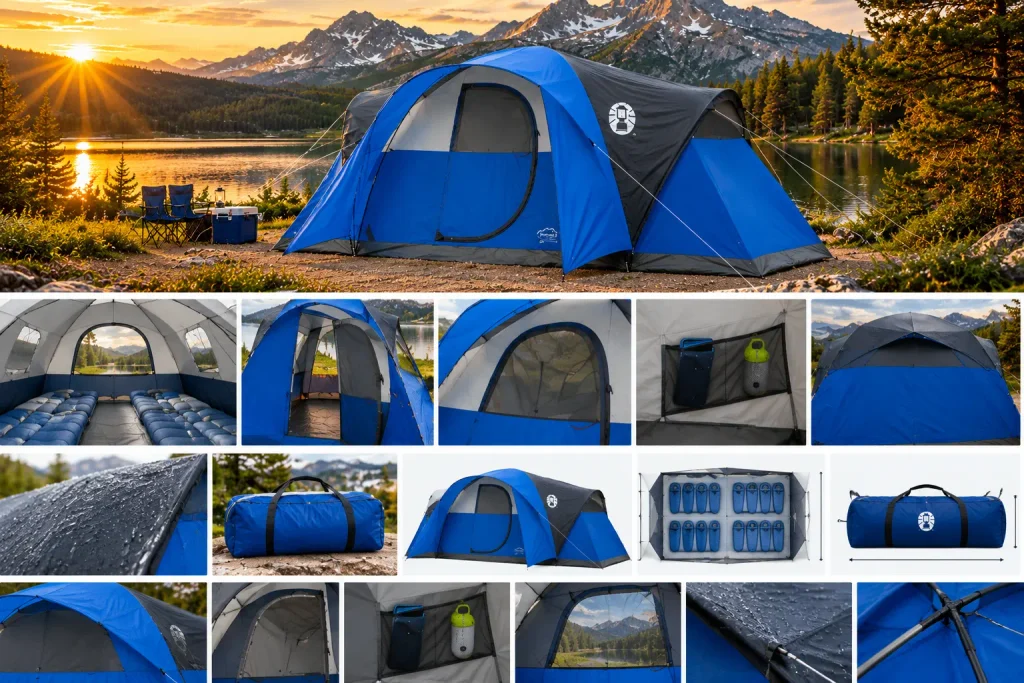
Doors: One hinged door the only tent on this list with a true hinged entry rather than a zip-and-roll flap, so it opens and closes more like a real door.
Windows: Mesh windows, though on the smaller side relative to how much wall fabric the tent has.
Room Divider: None single open room despite the larger capacity.
Storage Pockets: Small interior mesh pockets.
Ventilation: The weakest score on this list. With the rainfly on, the windows are modest and the rear wall is one large uninterrupted panel of fabric, so hot, still nights can feel stuffier than the smaller Sundome.
Rain Protection: Solid, though it let water through sooner in testing than the Sundome 6 around 15 minutes of sustained heavy rain before the first signs of moisture.
Portability: 23.4 lbs packed noticeably heavier and bulkier than the 6-person tents on this list, which tracks with the larger size.
Quality: Same fiberglass-pole, polyester-body construction as the rest of the Coleman lineup, with a front porch awning and the hinged door as the standout extras.
| Spec | Detail |
|---|---|
| Capacity | 8-person |
| Peak Height | 74.0 in |
| Base Area | 103.5 sq. ft. |
| Setup Time (solo) | 22 mins |
| Packed Weight | 23.4 lbs |
Pros
- Fits a genuinely larger family or group
- Front porch adds useful shade
- Unique hinged door is easier to use than a zip flap
Cons
- Longest setup time on this list
- Ventilation lags behind the smaller Sundome models
Verdict: The right call if you’ve outgrown a 6-person tent, as long as you’re prepared for a longer setup and slightly warmer nights.
We may earn a commission from qualifying purchases at no extra cost to you.
Which Family Tent Should You Buy?
Want one dependable, all-around family tent?
Go with the Coleman Sundome 6 it’s the best-balanced option on this list and the one we’d recommend to most families.
Camping somewhere hot?
The Coleman Sundome Dark Room 6 is worth the small upgrade for the cooler, darker interior.
Setup speed is non-negotiable?
The Core Equipment Instant Cabin 6 gets you pitched faster than anything else here, though you trade away some rain protection.
You want a bug-free hangout space?
The Coleman Evanston 6 and its screen room are hard to beat.
Your family has outgrown a 6-person tent?
Step up to the Coleman Montana 8 for the extra floor space.
Why Trust This Test
Every tent on this list was scored using the same eight-category framework spaciousness, quality, ease of use, comfort, features, ventilation, rain protection, and portability pitched and evaluated under matching conditions, including a hands-on rain test to see how each one actually holds up under sustained water exposure rather than relying on marketing claims.
Buying Guide: What Actually Matters in a Family Tent
How Much Peak Height Do You Actually Need?
Anything above 70 inches lets most adults stand fully upright near the center of the tent, which makes a real difference for changing clothes or just moving around without hunching over. All five tents here clear that bar except the Evanston 6, which trades a few inches of height for its screen room.
Is “Person Capacity” on the Label Realistic?
Not usually. A tent listed for 6 people is genuinely comfortable for 3-4 adults once you add sleeping pads, bags, and a bit of gear. Treat the marketed capacity as a ceiling, not a target.
Dome vs. Instant-Frame Which Setup Style Fits You?
Dome tents (like the Sundome, Evanston, and Montana) need poles threaded through fabric sleeves a little slower, but simple and lightweight. Instant-frame tents (like the Core Instant Cabin) have pre-attached poles that unfold into shape, trading some pack size for a much faster setup.
How Much Ventilation Is Enough?
Look for mesh panels on at least two opposite sides of the tent so air can actually move through, not just sit in one window. Tents with one small window and a lot of solid fabric like the Montana 8 tend to run warmer on still nights.
What Should You Expect From Rain Protection at This Price?
Budget family tents are built for fair-weather and light-to-moderate rain, not an all-night downpour. Every tent in this price range will eventually leak somewhere, usually at the floor seam, so seam-sealing that seam before your first trip is a smart, cheap investment.
Common Mistakes Buyers Make
- Buying based on the marketed person capacity instead of realistic livable space
- Skipping a practice setup at home before the first camping trip
- Not seam-sealing the floor before the first rainy trip
- Ignoring packed size and weight, then struggling to fit the tent in the car
- Assuming any of these tents are rated for anything beyond 3-season, fair-weather camping
Final Verdict
For most families, the Coleman Sundome 6 remains the smartest pick on this list it delivers real headroom, the best rain performance of the group, and a setup process anyone can manage solo. If your priorities shift toward heat management, setup speed, bug-free lounging, or extra floor space, the other four tents here each solve one of those problems specifically.
We may earn a commission from qualifying purchases at no extra cost to you.
FAQ
Can a 6-person tent really fit 6 people?
Technically yes, if everyone’s using a sleeping pad and doesn’t mind close quarters. Realistically, a 6-person tent like the Sundome 6 is far more comfortable for a family of 3-4 once you factor in gear and personal space.
Which of these family tents sets up the fastest?
The Core Equipment Instant Cabin 6, thanks to its pre-attached steel frame it comes together faster than any of the dome-style Coleman tents on this list.
Are these family tents waterproof in heavy rain?
Not indefinitely. All five hold up fine in light-to-moderate rain, but each one eventually lets water through during a sustained downpour, usually at the floor seam. The Sundome 6 held out the longest in testing.
Do any of these tents include a room divider?
No none of the five tents in this roundup include a built-in room divider. They’re all single open-room designs.
Is the Coleman Evanston 6’s screen room worth it?
Yes, if you spend time lounging outside the sleeping area and want to keep bugs out. Just don’t expect it to stay dry in real rain it needs a tarp for that.
How much bigger is the Montana 8 compared to the Sundome 6?
About 11 sq. ft. more base area and rated for two more people, but it also takes almost twice as long to set up solo and runs a bit warmer due to smaller windows.
What’s the biggest downside of instant-frame tents like the Core Instant Cabin 6?
Packed size and weight. The trade-off for that fast setup is a bulkier bag that takes up more trunk space than a comparable dome tent.