
Willd Nest is reader-supported. We may earn a commission from qualifying purchases at no extra cost to you.
At a Glance
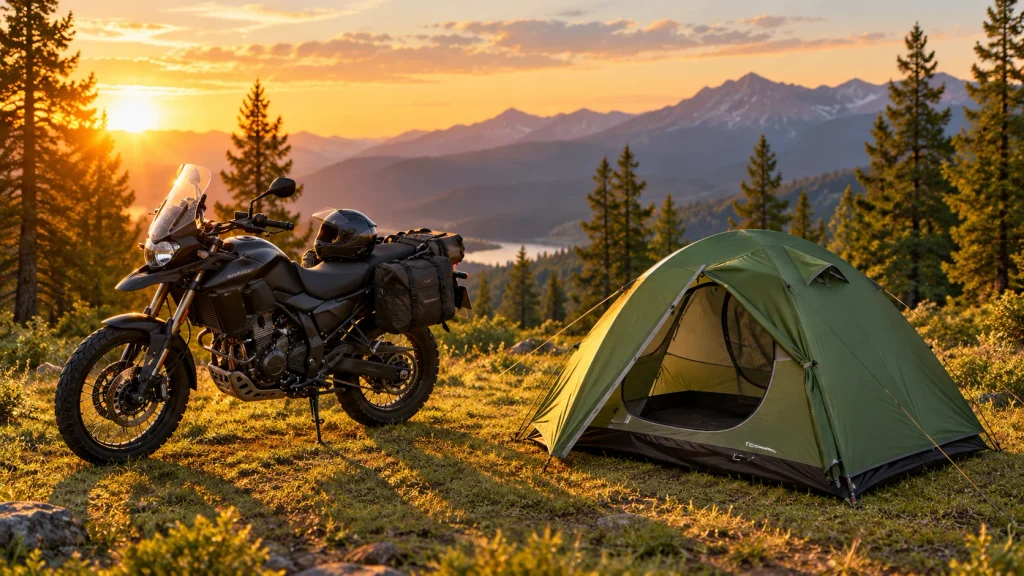
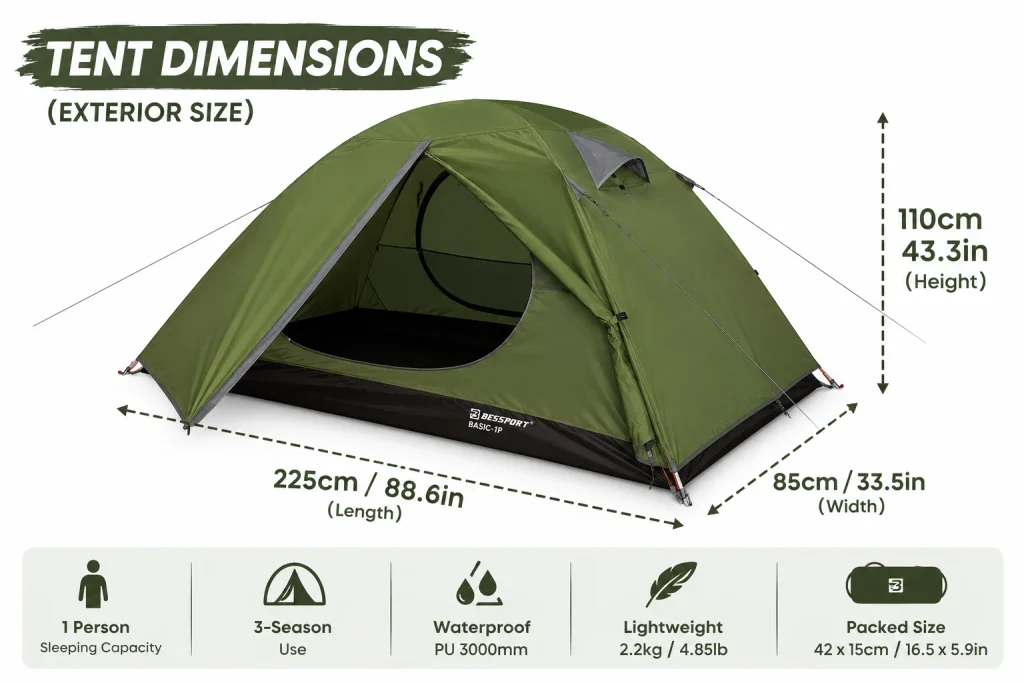
- Weight: about 4.4 lb (2 kg) as listed
- Packed size: 16.5 x 5.9 in (42 x 15 cm)
- Inside floor: 86.6 x 31.5 in
- Peak height: 43.5 in (110.5 cm)
- Doors and vestibules: 2 doors, 2 vestibules
- Waterproof ratings: rainfly PU3000, floor PU5000
Quick Answer
Motorcycle tent shoppers should look for light weight, a small packed size, and easy setup, and the Bessport 1P checks all three boxes for solo riders on paper. It weighs about 4.4 lb and packs to roughly 16.5 by 6 inches. You can’t stand inside, but it’s a smart pick.
What We Like and What Could Be Better
What we like
- Light, listed at about 4.4 lb
- Packs small, about 16.5 inches long
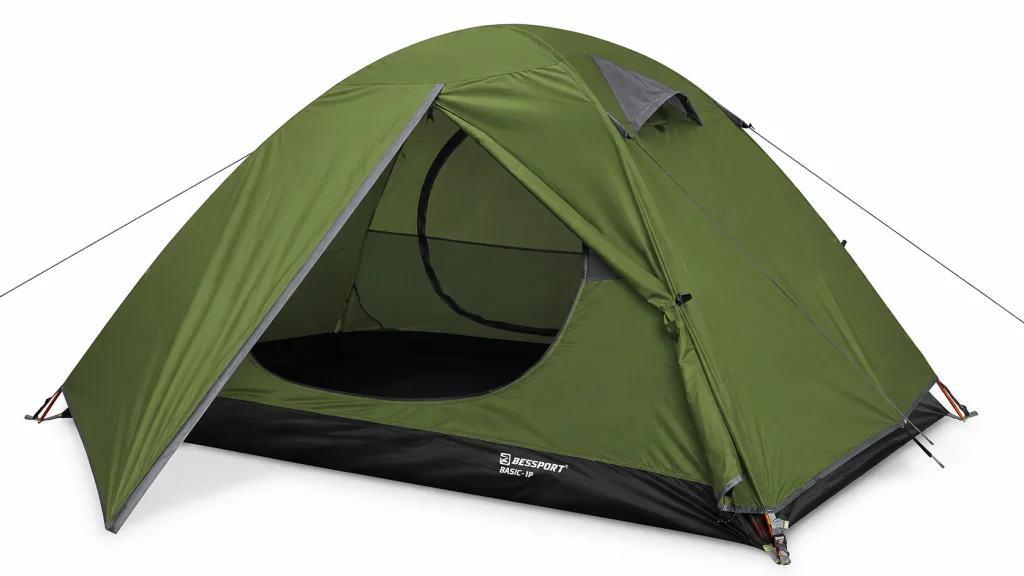
- Two doors and two vestibules, which is rare on a one-person tent
- Freestanding, so it holds its shape without stakes
- Taped seams and a full rainfly
- Mesh walls for airflow on warm nights
What could be better
- You can’t stand up, and the roof slopes down fast
- The floor is only 31.5 in wide, so a wide sleeping pad gets tight
- Vestibule size, pole material and fabric thickness aren’t published
- The ‘4 season’ label is hard to trust for heavy snow on a mesh-wall tent
- The weight in the listing text and the box photo don’t match exactly
What Actually Matters in a Motorcycle Tent
A motorcycle tent isn’t a special kind of tent. It’s a regular small tent that works well when your luggage space is tiny. Here’s what to check before you buy a tent for motorcycle camping:
- Packed size: Can it fit in a pannier, tail bag or on the passenger seat?
- Weight: Every pound counts on a loaded bike.
- Easy setup: You’ll often pitch it tired, hungry, and sometimes in the dark.
- Freestanding design: Roadside spots and gravel pull-offs don’t always take stakes.
- A vestibule: Helmet, boots and a riding jacket need somewhere dry to go.
- Rain protection: A taped-seam fly and a strong floor rating.
- Airflow: Riding gear gets sweaty, and a closed tent gets damp inside.
Now let’s see how the Bessport 1P matches up.
Bessport 1P Motorcycle Tent: Feature-by-Feature Breakdown
Bessport sells this as a backpacking tent, not a motorcycle tent. But the specs fit what solo riders need. The listing also covers 2-person versions. This review is only about the 1-person (1P) tent, which comes in green, grey and military green. The 2-person sizes are bigger, so the numbers below don’t apply to them.
All numbers come from the product listing and the manufacturer’s photos. We haven’t tested this tent.
What’s in the Box
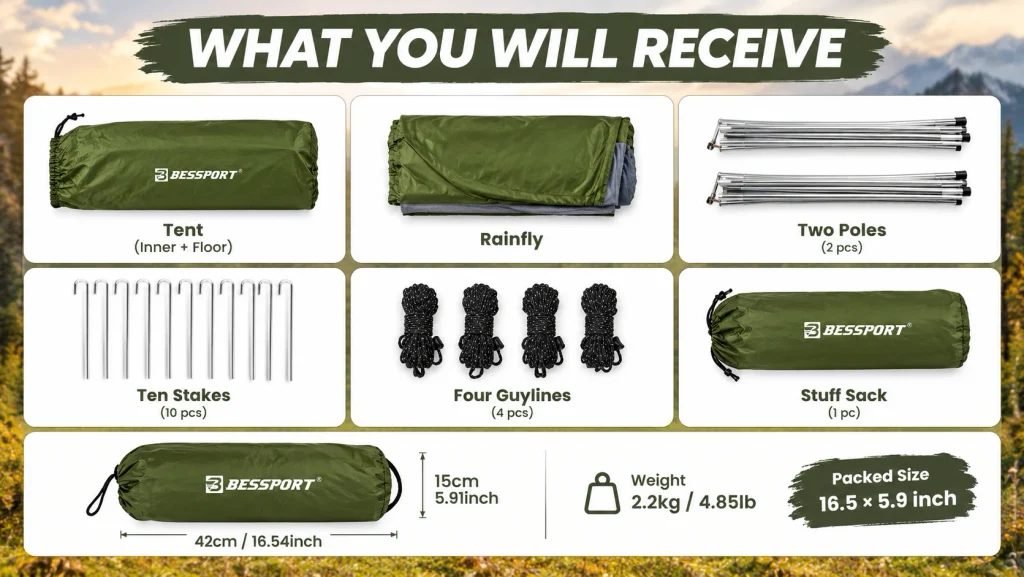
- Tent body (canopy): x1
- Rainfly: x1
- Frame poles: x2
- Stakes: x10 | Guylines: x4
- Stuff sack: x1
You get everything you need to pitch it. The ten stakes are more than the tent needs, which is handy if you lose one in the grass. The stakes are listed as 7001 series aluminum alloy.
Setup and Takedown
- Type: freestanding
- Poles: 2 poles with a clip system
- Setup time: not published
Freestanding means the poles hold the shape on their own. You can pitch it first and stake it second. The clip system means you clip the tent onto the poles instead of threading poles through long sleeves. That’s usually quicker.
The listing doesn’t give a setup time, so we won’t guess one.
Pro Tip: Pitch it once at home before your first trip. You don’t want your first try to happen at dusk after a long ride.
Freestanding also helps on hard ground. If stakes won’t go into gravel or packed dirt, the tent still stands. Put rocks or a heavy bag inside to hold it down.
Peak Height and Standing Room
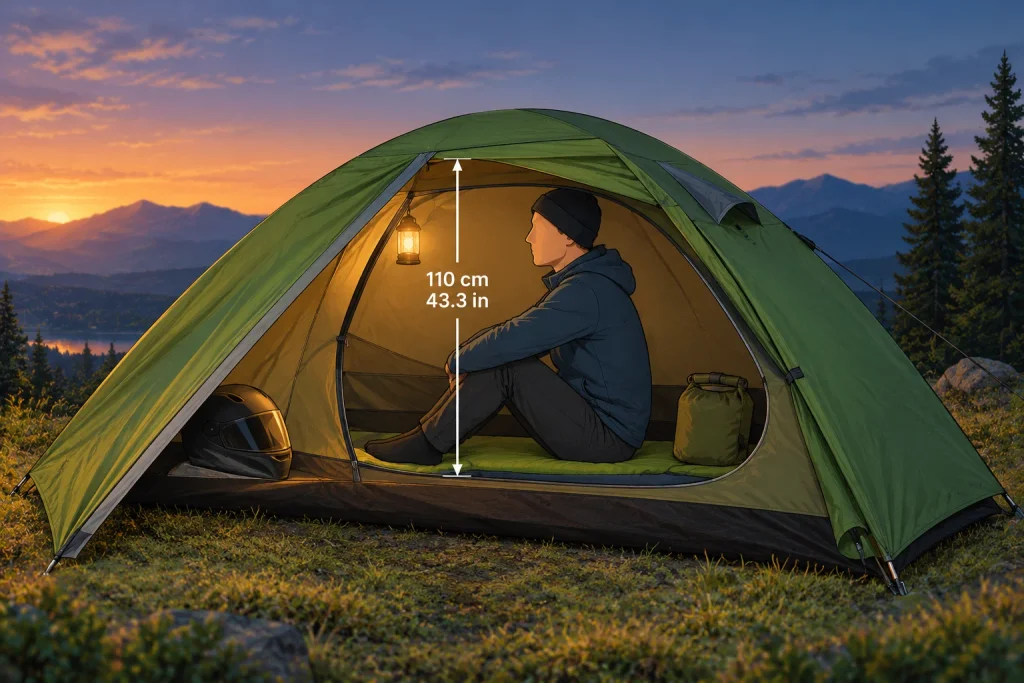
- Inside height: 43.5 in (110.5 cm)
- Standing room: none
You can sit up straight near the middle, but you can’t stand or kneel in the corners. That’s normal for a one-person tent. For a rider who wants to sleep, change clothes sitting down, and stay out of the rain, it does the job.
Floor Area and Sleeping Capacity
- Inside floor: 86.6 x 31.5 in (220 x 80 cm)
- Listed canopy area: 21 sq ft
- Sleeps: 1 person
Here’s what that means. A 6-foot rider is about 72 inches long, so you’d have about 14 inches left over for a pillow and a small dry bag. A regular sleeping pad is about 20 inches wide and a wide pad is about 25 inches (sizes vary by brand). Both fit, but with a wide pad you only have about 6 inches of space beside you.
The listing says 21 sq ft. Simple math from the floor size gives about 19 sq ft, so treat 21 as the top end.
Your riding luggage won’t fit inside with you. That’s what the vestibules are for.
Doors
- Number of doors: 2
- Shape: D-shaped
Two doors on a tent this narrow is a real plus. You can leave on either side without climbing over your gear. If one side faces a wet bush or your bike, use the other.
Mesh Walls and Ventilation
- Walls: no-see-um mesh
- Design: rainfly over a separate inner tent (double wall)
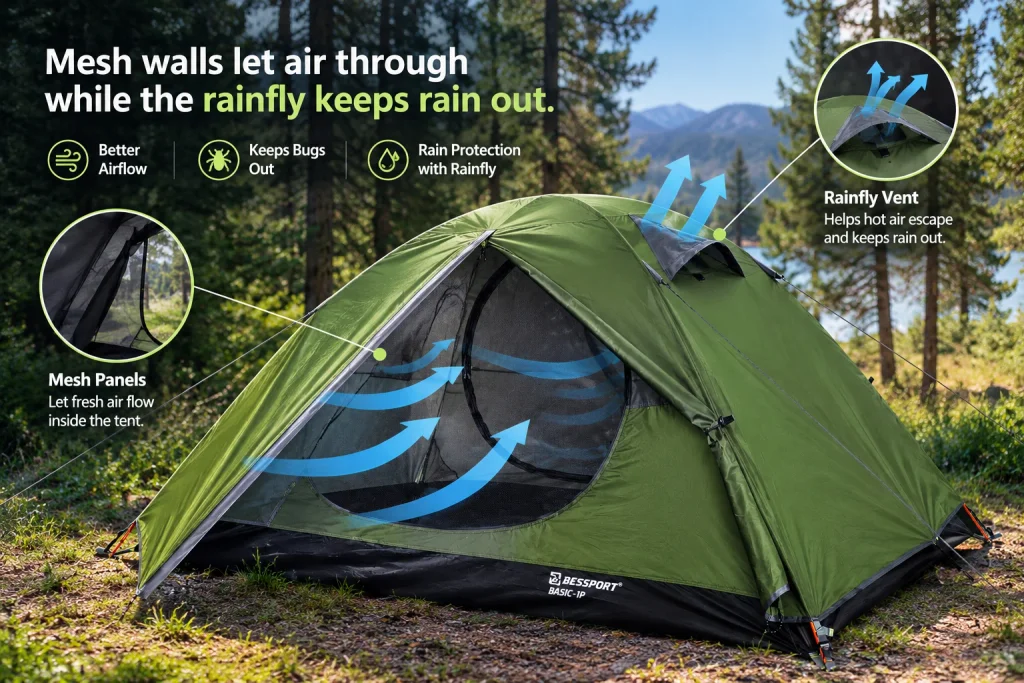
No-see-um mesh has tiny holes. It keeps out mosquitoes and small bugs but lets air through. Riders get hot, and warm nights can feel stuffy, so this matters.
The manufacturer’s photos also show a hooded vent near the top of the rainfly, though the listing text doesn’t mention it. A double-wall design lets air move between the layers, which helps with condensation (the water drops that form inside on cool nights). It won’t stop it completely. If it’s damp, open a door a little.
Vestibules: Where the Helmet and Boots Go
- Vestibules: 2 (one per door)
- Size: not published
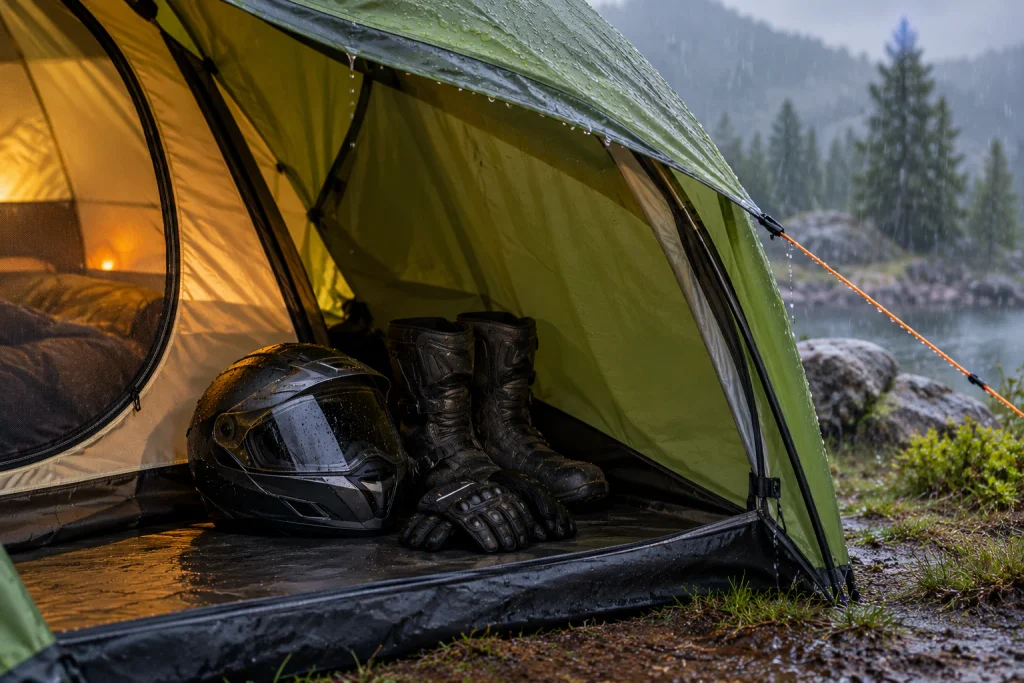
This is the feature riders will like most. A helmet, boots, gloves and a riding jacket take up a lot of room, and you want them dry. On a tent this narrow, each vestibule will likely hold a pair of boots and a helmet, not full luggage. The listing doesn’t give measurements, so check the photos before you buy.
Keep your valuables with you. A tent can’t be locked.
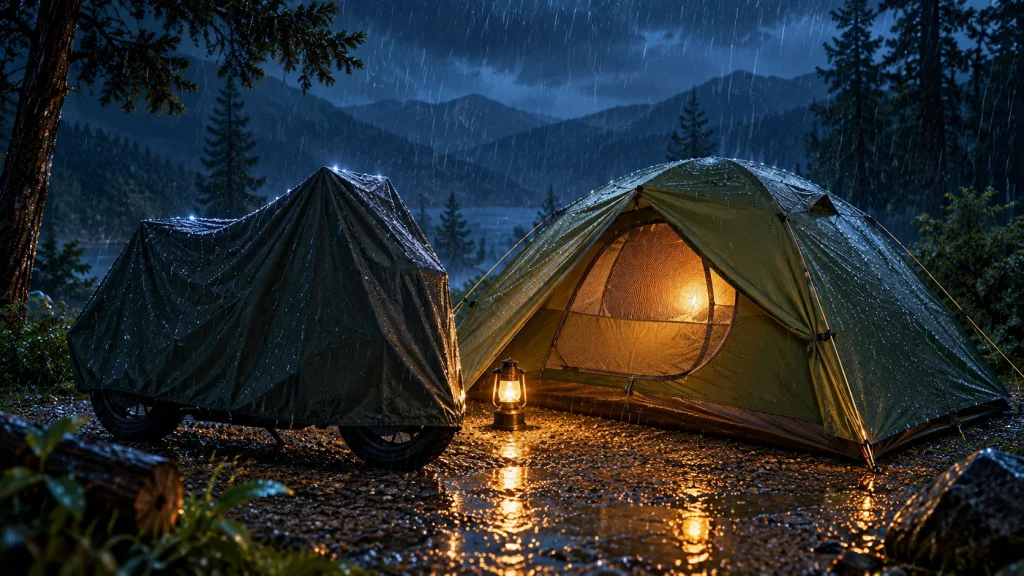
Rain and Weather Protection
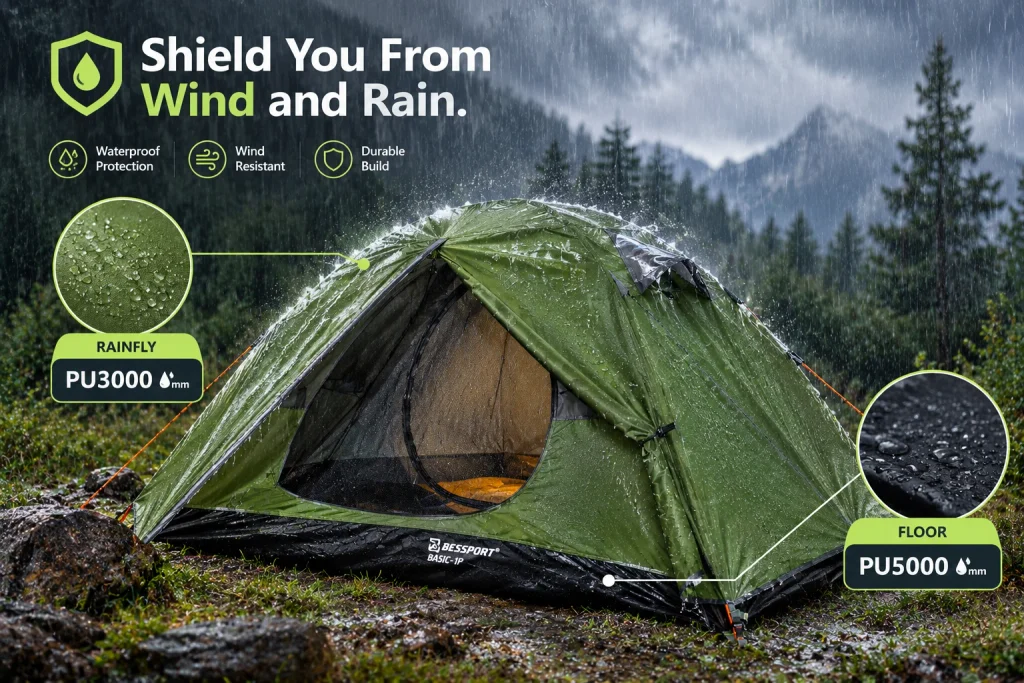
- Rainfly rating: PU3000
- Floor rating: PU5000
- Seams: taped
- Floor: welded, raised off wet ground
- Rainfly coverage: full
PU is the waterproof coating on the fabric. The number is how much water pressure it can hold, in millimeters, before water pushes through. 3000 means 3,000 mm. A rating above about 1,500 mm is usually enough for normal rain, so 3,000 mm is a solid number. The floor gets a higher rating because your weight pushes it into wet ground.
Taped seams matter too. Water often gets in through the stitch holes, and tape covers them.
The listing calls this a ‘4 season’ tent. We’d be careful with that label. Mesh walls and a light two-pole frame are built for airflow, not for heavy snow or strong cold wind. Based on its design, we’d call it a three-season tent for spring, summer and fall. If you ride in snow, look for a tent made for it.
Before any trip, check the forecast on weather.gov.
Wind Resistance
- Guylines: 4, reflective
- Stakes: 10
- Wind rating: not published
Guylines are the cords that pull the rainfly tight. The reflective cord also shows up in a flashlight beam, so you’re less likely to trip on it at night.
Riders often camp on open ground, like trailheads and roadside spots, where wind can hit hard. Use every guyline and stake. Pick a spot with natural cover, like trees or a slope, and point the narrow end into the wind.
Build Quality and Materials
- Stakes: 7001 series aluminum alloy
- Floor: welded
- Pole material and fabric thickness: not stated
This is a place where the listing stays quiet. We can’t tell you how thick the fabric is or what the poles are made of, and we won’t make it up. At this weight, treat it with care. Clear sharp stones and sticks from the ground before you pitch, and use a ground sheet on rough ground.
Packed Size and Portability
- Packed size: 16.5 x 5.9 in (42 x 15 cm)
- Weight: about 4.4 lb (2 kg) in the listing
- Pole length: not published
The listing text says 4.4 lb (2 kg), but the box photo shows 2.2 kg (4.85 lb). One number may include the stuff sack and stakes. Plan on about 4.4 to 4.85 lb.
That packed size is about as big as a small compressed sleeping bag. It can ride across a passenger seat or sit in a larger pannier. The folded pole length isn’t listed, so check that before you plan to slide it into a narrow bag.
Quick spec table
| Spec | Published value |
|---|---|
| Occupancy | 1 person |
| Weight | 4.4 lb (2 kg) |
| Floor | 86.6 x 31.5 in |
| Height | 43.5 in |
| Packed size | 16.5 x 5.9 in |
| Rainfly | PU3000 |
| Floor rating | PU5000 |
| Doors | 2 |
| Vestibules | 2 |
| Included | Poles, stakes, rainfly, guylines, sack |
How to Pack a Tent on a Motorcycle
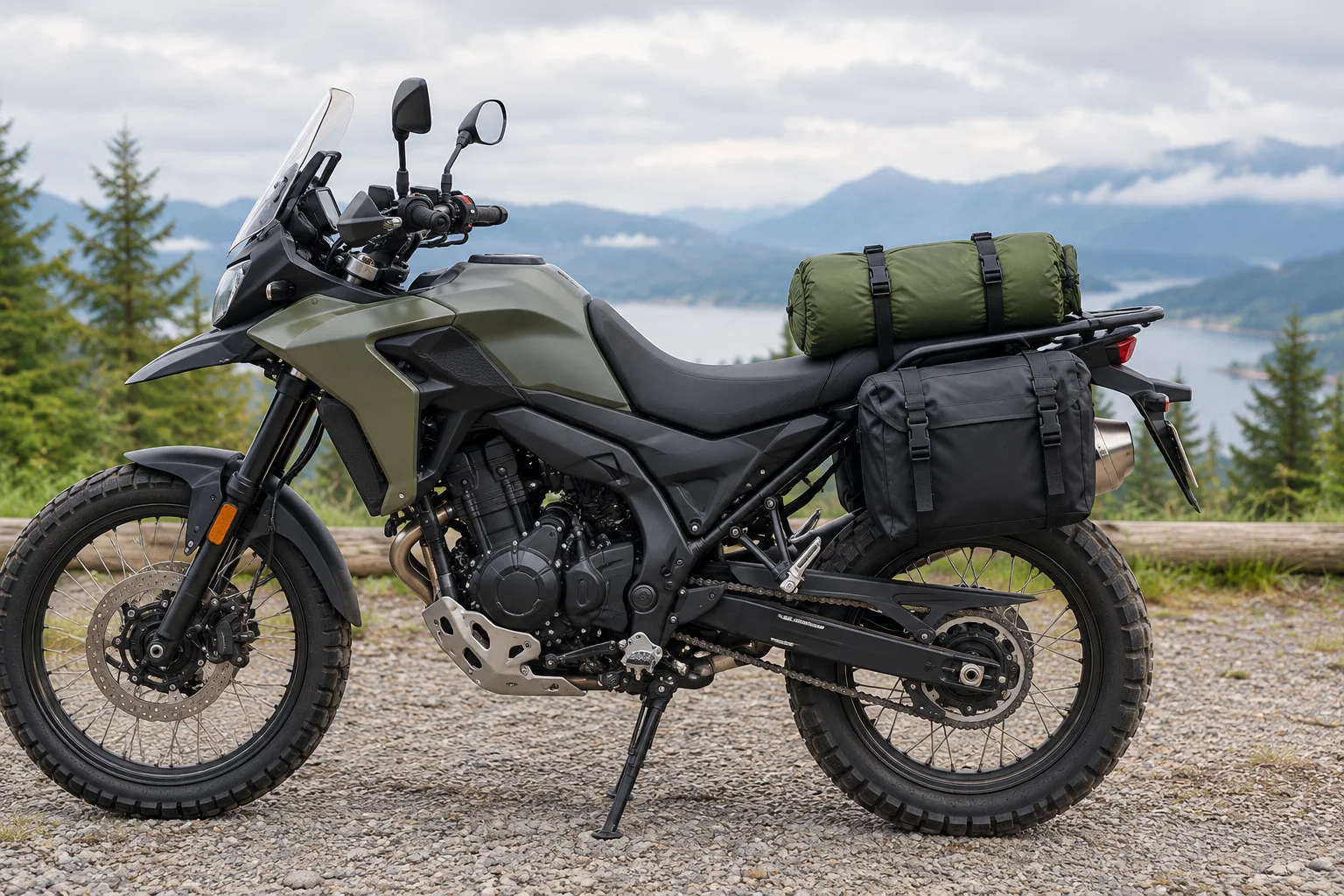
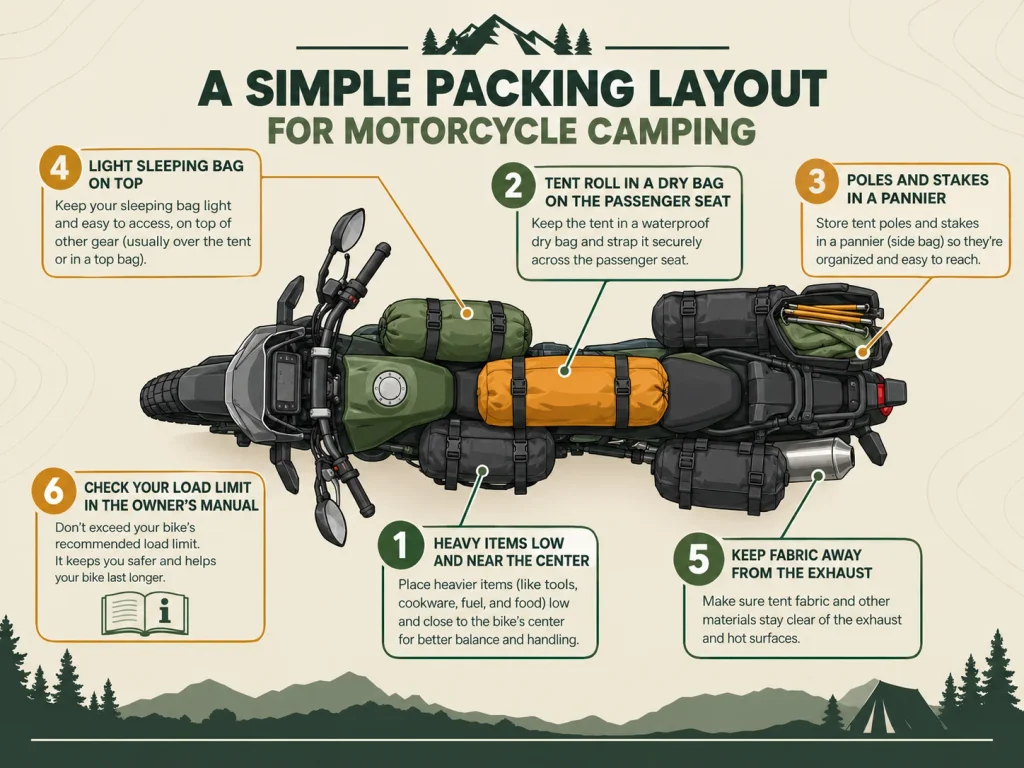
You can carry a one-person tent on almost any touring or adventure bike. Here are simple tips:
- Check your load limit. Your owner’s manual has the maximum weight for your bike. Add up your tent, bags and gear.
- Keep heavy items low and close to the center. Weight high or far back makes the bike feel top-heavy.
- Use a dry bag. Even a rainfly gets wet, and a wet tent in a dry bag keeps your other gear dry.
- Stay away from the exhaust. Tent fabric melts. Strap it on the passenger seat or a rack, never near hot parts.
- Don’t let poles stick out. Slide them into a pannier or secure them along the frame, within the width of the bike.
- Do a test ride. Ride around the block with the full load before you leave.
For general rider safety advice, see the NHTSA motorcycle safety page. When you set up camp, follow the Leave No Trace principles.
Pro Tip: Carry a small flat puck or board for your kickstand. On soft ground it keeps your bike from sinking.
Who This Motorcycle Tent Is (and Isn’t) For
It’s a good match if you:
- Ride solo and want a light tent for motorcycle camping
- Camp in spring, summer or fall
- Care more about small size than space
- Want somewhere dry for your helmet and boots
Look elsewhere if you:
- Camp as a couple, because you’ll want the 2-person size or bigger
- Want to stand up or sit around inside
- Ride in snow or very cold, windy places
- Need to store full luggage inside the tent
- Camp with family. See our best family tents guide instead
Why Trust This Guide
We haven’t tested this tent. This review is based on the product listing, the manufacturer’s photos and graphics, and simple math from the published numbers. For each spec, we explain what it means for a rider, and we say plainly when the listing leaves something out. We never use a price or star rating from Amazon in our reviews, because those change. You can read how we earn money on our Disclosure Policy page.
We update this page when the product details change.
Buying Guide: How to Choose a Motorcycle Tent
The best tent for motorcycle camping is a small, light, freestanding tent with a vestibule. Here’s how to pick one.
How big should a motorcycle tent be?
Choose a tent that fits you and one sleeping pad, nothing more. A 1-person tent saves the most space and weight. If you want more room for gear, a 2-person tent is a good step up, but it will pack bigger and weigh more.
How light should a lightweight motorcycle tent be?
Aim for about 5 lb or less for a solo tent. The Bessport 1P is listed at about 4.4 lb, so it fits. Remember that the lighter the tent, the thinner the fabric usually is.
How small should it pack?
Measure your luggage first. If your pannier is 16 inches deep, a tent that packs to 16.5 inches won’t slide in flat. Check the packed length and the pole length.
Do you need a freestanding tent?
Yes, if you camp on hard ground. A freestanding tent stands without stakes. That helps on gravel, sand or packed dirt where stakes won’t go in.
Do you need a vestibule?
Yes. A vestibule keeps boots, gloves and your helmet dry and out of your sleeping space. Two vestibules are better than one.
Common Mistakes Buyers Make
- Buying too big. Extra space means extra weight and a bigger roll on the bike.
- Ignoring packed length. A tent that doesn’t fit your bag rides on top and sticks out.
- Trusting the ‘4 season’ label. Check the design, not just the name.
- Skipping a test pitch. Learn the tent at home, not in the dark.
- Forgetting a ground sheet. It protects a thin floor from sharp rocks.
Final Verdict: Is the Bessport 1P a Good Motorcycle Tent?
For a solo rider, yes. This motorcycle tent is light, packs small, has two doors and two vestibules, and has a taped-seam rainfly with solid waterproof ratings on paper. It’s not roomy, and you can’t stand in it. But a good motorcycle tent is more about what it saves you than what it adds.
If you want a simple, light tent for spring to fall rides, the Bessport 1P is a sensible choice. If you ride in snow, camp with a partner, or want room to move, pick something else.
As an Amazon Associate I earn from qualifying purchases.
FAQ
What is the best tent for motorcycle camping?
The best motorcycle tent is light, packs small, and sets up easily. It should also be freestanding and have a vestibule for gear. A 1-person backpacking tent like the Bessport 1P fits these needs for solo riders who camp in mild to wet weather.
How big should a motorcycle tent be?
A solo rider only needs a tent that fits one person and one sleeping pad. A 1-person tent around 85 inches long and 30 to 35 inches wide is plenty. Bigger tents add weight and take more space on the bike.
Can you fit a tent on a motorcycle?
Yes. A one-person tent that packs to about 16 inches long fits on the passenger seat, a rack, or in a large pannier. Keep it away from the exhaust, stay within your bike’s load limit, and do a test ride.
Is the Bessport 1-person tent waterproof?
The listing gives the rainfly a PU3000 rating and the floor a PU5000 rating, with taped seams and a full rainfly. That’s good for normal rain. How well it works also depends on how you pitch and stake it.
Is a 2-person tent better for motorcycle camping?
A 2-person tent gives more room for gear and a little more headroom, but it’s heavier and packs bigger. For one rider with limited luggage space, a 1-person tent is usually the smarter choice.
Can you stand up in the Bessport 1P?
No. The inside height is listed at 43.5 inches. You can sit up near the middle but you can’t stand or kneel in the corners.
Is the Bessport tent really a 4 season tent?
The listing says so, but we’d call it a three-season tent based on its design. Mesh walls and a light two-pole frame are made for airflow, not for heavy snow or strong cold wind.